

Summary
- Naila Nomoa won individual Chief Executive’s Award.
- PUPS won team award for end-of-life care.
- Awards drew 93 nominations across Torres and Cape.
A Torres Strait Islander cultural educator and a palliative care team helping people return home to Country at the end of life have received the top honours at the 2026 Torres and Cape Hospital and Health Service (TCHHS) Awards for Excellence.
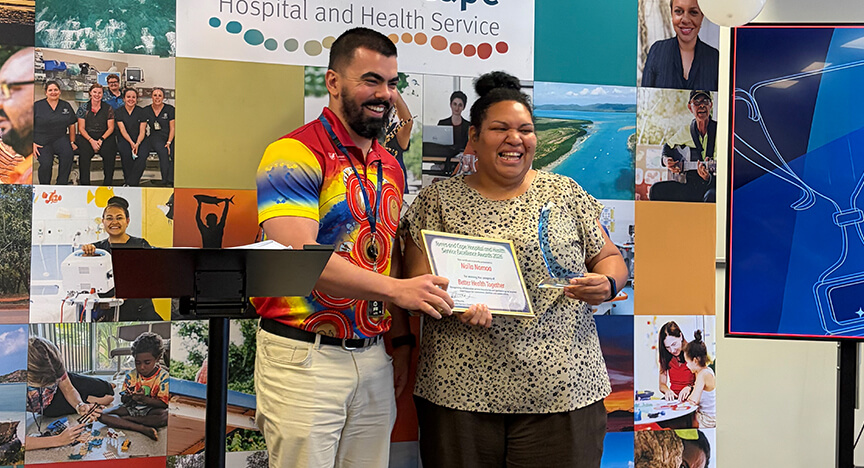
Cultural Practice Program Coordinator Naila Nomoa received the Chief Executive’s Award for an individual, and the Pop-Up Palliative Care Service (PUPS) received the Chief Executive’s Award for a team. The awards were presented on Thursday 26 November.
This year’s awards attracted 93 nominations from staff across Cape York, the Northern Peninsula Area and the Torres Strait.
Naila Nomoa – strengthening culturally safe care
Naila, who calls Badu Island home, coordinates and delivers the TCHHS Aboriginal and Torres Strait Islander Cultural Practice Program to all staff and to external partners. The program builds understanding of the region’s cultures and history so that staff can provide safe, respectful and culturally responsive care.
This year Naila delivered 25 sessions to more than 315 staff, bringing completion of the program across the health service to 81 per cent. She ensures the program is delivered by facilitators who come from, or have deep experience working in, the communities TCHHS serves.
TCHHS Chief Executive Rex O’Rourke said Naila had a rare gift for helping people learn.
“Naila’s contribution to our Cultural Practice Program is changing the way our staff understand and deliver care. With more than 80 per cent of our workforce now having completed the program, the impact of this work is being felt in every community we serve,” Mr O’Rourke said.
“Her colleagues describe her as a bridge between people and cultures, and I can’t think of a better way to put it. This award is thoroughly deserved.”
“This award belongs to everyone who has shared their culture, their stories and their time to make the program what it is, especially our facilitators from the communities we serve,” Ms Nomoa said.
“When staff understand the people and places they work with, they deliver better, safer care. I’m proud to share my culture from Badu Island and to help our health service walk alongside our communities.”
PUPS – bringing people home to Country
The Pop-Up Palliative Care Service began as a pilot and has grown into a team of nurses, health workers, administration and allied health professionals. It combines telehealth with on-the-ground support to help people with a life-limiting illness be cared for at home, surrounded by family. Around 83 per cent of people referred to the service are supported to return home to Country to pass.
The team keeps specialty beds and equipment ready across the region and trains families, health workers and clinicians to care for people at home.
Over the past two years PUPS has introduced portable cooling blankets across TCHHS. They allow families to keep a loved one at home or in their community for longer, including on islands without a morgue, giving relatives time to gather, say goodbye and observe cultural practices and Sorry Business. In one community, the system gave a family an extra 20 hours with their loved one.
The initiative has already been recognised at the Queensland Palliative Care Awards, and the team has been nominated for the Palliative Care Australia awards.
“PUPS has become one of the most valued services we deliver,” Mr O’Rourke said.
“Being able to return home to Country at the end of life, surrounded by family, matters deeply to our communities. The cooling blankets are a simple idea that has made an enormous difference, and the team’s constant drive to listen, evaluate and improve is exactly what excellence looks like.”
PUPS Clinical Nurse Consultant Kirsten Standage said every family and every community was different.
“Our job is to listen, and to make it possible for people to be cared for at home, on Country, in the way they want,” Ms Standage said.
“The cooling blankets give families precious extra time to gather, say goodbye and practise culture. We’re grateful to the families who have trusted us, and to the health workers and clinicians across the region who make this care possible.”
Other category winners
Other 2026 Awards for Excellence winners were:
- Oral Health Services (Excellence in Care Delivery), for doubling its dentist workforce and re-establishing dental services in the Torres Strait Islands.
- Chloe Brooking, Digital Health (Transforming Healthcare), for building a community health dashboard that helps clinicians identify who is due for care.
- the Health Surveillance Team (Supporting Healthcare), whose electronic medical record reminders made patients 13.4 times as likely to receive an overdue immunisation
- Rosemary MacLeod, Lockhart River (TCHHS Values Award).
- joint winners Breanna Appleby, Nursing Clinical Education, and Steve Wallin, Director of Medical Imaging (Leading with Purpose).