

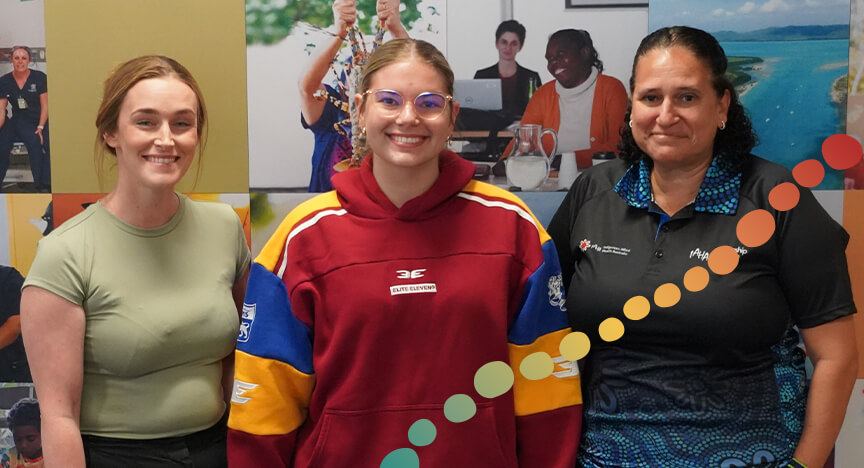
For First Nations graduate Helena David and cadet Layla Broderick, family is all about giving back.
The pair aim to work in the Torres Strait and Cape York and help communities tackle health issues that had affected their own families.
Double degree holder Ms David said she was “learning the ropes” at the Child Development Service. With experience in community controlled and private practice she will move into a psychologist role in 2026.
Ms David brings her own culturally informed lens to the Allied Health team.
“It’s the middle, central Torres Strait islands that I identify to, but grew up here on the mainland,” she said.
Drawn perinatal mental health care, Ms David’s focus is on perinatal care for mums for whom English is a third or fourth language.
“I think the biggest thing is the language up in the Straits. The language difference and the culture, the differences there and the perspective I can bring for that particularly,” she said.
“Mums going through pregnancy and then having a baby, the pressures around that and the mental health issues around that area.”
The Allied Health workforce is currently growing with a focus on investing in First Nations staff who are completing or have recently completed their studies, to grow their expertise and skillsets at TCHHS.
Layla Broderick was the first to be recruited as an Allied Health First Nations HP cadet. She is working her way through a six-week program during which she will shadow physiotherapists and rural generalists in Cooktown and Weipa.
The Physiotherapy student has kinship ties to the Wuthathi family group near Lockhart River and to the Torres Strait Islands.
Her journey to a career in healthcare was inspired by her grandmother’s experience with chronic disease.
“Growing up, I was very close with my Nan,” Ms Broderick said.
“She had a bit of medical issues and seen doctors for about nine years, they couldn't work out what was wrong with her.
“Then they basically narrowed it down to that she has lupus. And because her diagnosis was nine years late, she ended up with all the secondary aspects of it, lung diseases, respiratory diseases.
“I went to the hospital a lot with her, with my mum and my cousins. I saw the work that the physiotherapists did, especially the cardiorespiratory. I'm thinking of specialising in cardiorespiratory.
“I really just want to be a part of that early intervention process.”
Ms Broderick said the difficulties for remote communities to access specialist healthcare drove her to seek experience working in remote areas.
“My goal is to also go and give back to the communities because I am aware that they don't have a lot of health services up there … there's limited opportunities for them to see, especially allied health workers and physiotherapists, unless they're travelling down, which is not an opportunity most people get up there. I'd really love to give back and be a part of that outreach process.”